
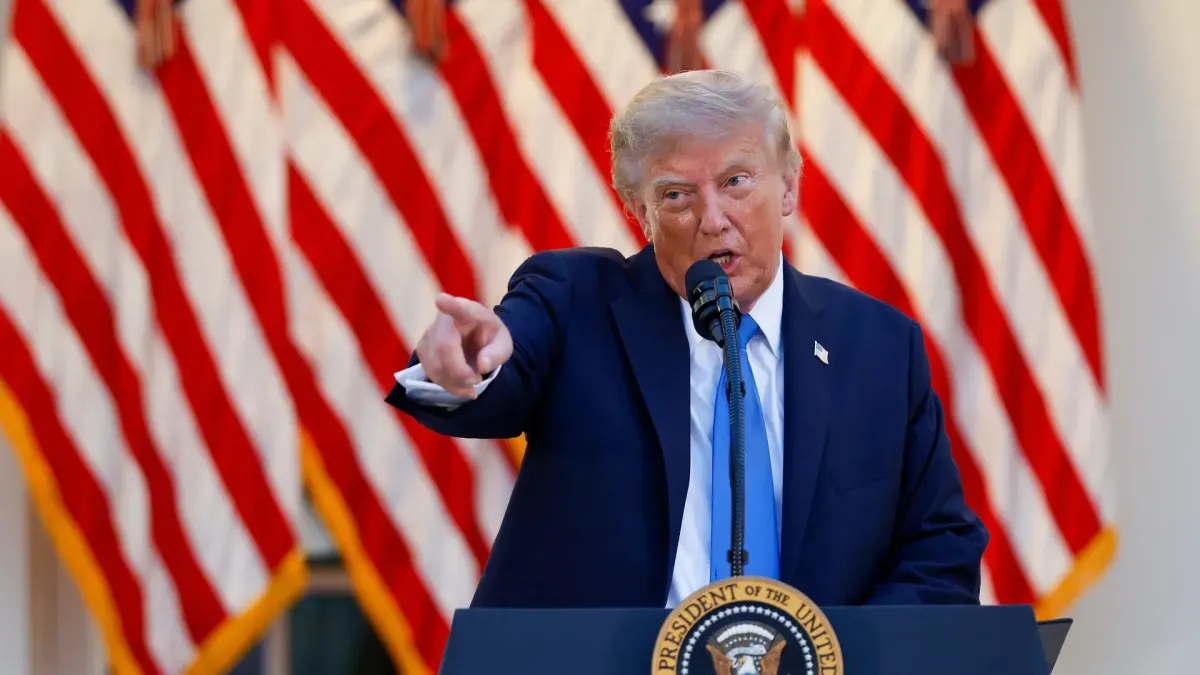
Five thousand dollars is real money. It covers a few months of rent in most of the country, a used car, a dent in a credit card balance running at 25% interest. So when Donald Trump stood on stage at the Republican Party's first-ever midterm convention in Dallas on Wednesday night and promised exactly that to every American adult, he knew precisely what he was doing.
"If the Republicans win the House of Representatives and the United States Senate, both of them, I will issue a dividend to every adult citizen in the United States of America for $5,000," Trump told the crowd during a prime-time address that ran an hour and 45 minutes. He said the money would have to be spent inside the United States. He called it the Trump dividend. "Now all we have to do is win," he added.
That last line is the whole story.
The math and the fine print
With roughly 270 million American adults, a universal $5,000 payment pencils out to about $1.35 trillion, a figure Reuters and CBC both reported. For scale, that is in the same neighborhood as the entire defense budget for fiscal 2026, which came in around $1.36 trillion, and more than the $1.27 trillion the Treasury has paid in interest on the national debt so far this fiscal year. A single $5,000 check would also exceed what most Americans received in direct government payments during the COVID relief of Trump's first term.
The president cannot simply write these checks. Under the Appropriations Clause, spending of this size requires an act of Congress, and Trump did not explain how the payments would be funded or administered. He floated tariff revenue as a partial source, but offered no mechanism, and that well may be dry: the Supreme Court ruled against the administration's tariff regime in February 2026, which is one reason an earlier $2,000 "tariff rebate" idea never happened. The White House did not respond to requests for detail.
The timing matters. The federal deficit is approaching $1.8 trillion for the fiscal year, roughly 5.8% of GDP, and total debt sits near 122% of GDP. Government borrowing costs have been climbing. Layering $1.35 trillion on top of that, with no identified funding source, means borrowing it. The interest on that borrowing would be paid by taxpayers for decades, long after the $5,000 is spent.
The pattern behind the promise
This is at least the third time Trump has dangled a personally branded cash payment, and the first two never arrived. Early in his second term he backed a $5,000 "DOGE dividend" funded by supposed government efficiency savings. It went nowhere. Then came the $2,000 tariff rebate, which died with the Supreme Court's tariff ruling. Earlier this year he talked up a $2,000 dividend and claimed he might not even need Congress. Nothing materialized.
A reasonable reading of that track record suggests the dividend functions less as fiscal policy and more as a campaign instrument. The promise costs nothing to make. It only becomes expensive if it is kept, and by then the election it was designed to influence is over.
What is new this time is the explicit condition. Previous versions were floated as policy. This one is wired directly to the ballot box: Republicans hold Congress, you get paid. The announcement drew immediate comparisons to Elon Musk's cash giveaways during the 2024 cycle and the 2025 Wisconsin Supreme Court race, and it put Trump's own allies in an awkward spot. Fox News anchor Bret Baier pressed Vice President JD Vance on air, noting the $1.3 trillion price tag and the accusations of vote buying.
The legal gray zone
Federal law has something to say about money and votes. Under 18 U.S.C. § 597, offering a payment to induce someone to vote or to vote a particular way is a crime. A related statute, 18 U.S.C. § 600, criminalizes promising congressionally funded benefits as a reward for supporting a political party. Legal commentators were quick to flag both.
The counterargument, offered by election law specialists quoted in the New York Times, is that the promise could be framed as a pledge to cut taxes or deliver benefits through legislation, which politicians do constantly and legally, and that Trump's speech may be protected under the First Amendment. That defense is plausible. Campaign promises of benefits, from farm subsidies to student loan forgiveness, are a staple of American politics. What makes this one different is the directness of the transaction: a named dollar figure, a named beneficiary, an explicit electoral trigger, and the president's own name on the product.
Whether prosecutors would ever test that distinction is another question entirely. The practical barriers to the dividend, namely Congress, the money, and the courts, are more likely to kill it than any criminal statute.
Why now
The context is a president with sinking approval numbers heading into a midterm where Democrats hold a projected lead in the race for the House, according to the New York Times polling tracker. Affordability ranks as the top voter concern, with oil above $100 a barrel after the U.S.-Israel conflict with Iran disrupted shipping through the Strait of Hormuz. Many Republican lawmakers skipped the Dallas convention altogether. Trump, by contrast, put himself at the center of the election and put a price on loyalty: hold the line for my party, and there is $5,000 in it for you.
Critics like stockbroker Peter Schiff warned that financing the payout would fuel inflation worse than anything seen under Biden. That is a forecast, and a contested one, but the underlying logic is not exotic: injecting $1.35 trillion of borrowed money into consumer spending, at a moment of elevated inflation and $100 oil, is the kind of thing that tends to show up later in prices and interest rates.
Which points to the deeper structure of the offer. The benefit is immediate, personal, and branded. The cost is deferred, diffuse, and anonymous, spread across every taxpayer and future borrower. That asymmetry is not an accident of the design. It is the design. And it works whether or not a single check is ever cut, because the promise alone may move votes in November, and the bill, if it ever comes due, arrives after the counting is done.
Free Game Takeaway
Do not budget this money. The Trump dividend requires Republicans to hold both chambers of Congress in November, then requires Congress to actually appropriate roughly $1.35 trillion with no funding source identified, against a deficit already near 6% of GDP. Two earlier Trump cash promises, the DOGE dividend and the tariff rebate, both evaporated. The signals worth watching: whether any actual legislation is introduced and scored by the Congressional Budget Office, whether the White House ever produces a funding mechanism beyond vague tariff talk, and how the bond market reacts, because a serious $1.35 trillion borrowing plan would push Treasury yields, and with them mortgage, auto, and credit card rates, higher. The practical lesson is older than this proposal: when a politician attaches a cash prize to an election result, the prize is the campaign strategy, and the payout is optional. Judge the offer by the track record of delivered checks, which currently stands at zero.