|
| “We do not accept the narrative that young men, particularly Black men, are disengaged from higher education.” — Dr. Roslyn Clark Artis, President and CEO of Benedict College |
|
|
Good Morning! Today's lead is a genuinely countercultural business story: while Black male college enrollment keeps sliding nationally, one HBCU in Columbia, South Carolina just delivered its second consecutive majority-male incoming class, and its biggest freshman intake since 2019. The playbook is more interesting than the headline.
Elsewhere, Wall Street opened the week with a tech-powered rally that pushed the Nasdaq to a record close and AMD past a trillion dollars in market value, oil slipped below $100 on hopes of renewed U.S.-Iran talks, and Washington is bracing for Thursday's Trump-Xi summit, where AI, tariffs, and a war are all on the agenda. We also track Paramount's settlement clearing its $81 billion Warner Bros. Discovery deal, the Fed's first rate hike in three years, and a quiet fight over who gets to keep teaching Black and Latino studies in Texas.
|
|
FREE GAME OF THE DAY
How Benedict College Built Two Straight Majority-Male Freshman Classes While Black Male Enrollment Falls Everywhere Else
 Photo by Stanley Morales on Pexels · Pexels License Benedict College, the private HBCU in Columbia, South Carolina, welcomed 731 new traditional undergraduates this fall, its largest incoming group since 2019 and a 15.3 percent jump over last year. Buried in that headline number is the real story: for the second consecutive year, men make up the majority of the incoming class, 53 percent this fall after 54 percent in Fall 2025.
Now consider the backdrop. Men account for just 42 percent of all U.S. undergraduates, according to the National Center for Education Statistics, and at HBCUs the average is closer to 37 percent male, with women holding roughly 63 percent of seats. The long arc for Black men is worse: AfroTech, citing research from the American Institute for Boys and Men, reports the share of Black men enrolled at HBCUs fell from 38 percent in 1976 to 26 percent in 2024. Benedict is running hard in the opposite direction.
This did not happen by accident or by ad campaign. Enrollment chief Yohannis Job credits expanded outreach to young men through schools, churches, and mentorship programs. On campus, the college built visible structures of belonging: Barber Shop Talks, hosted by its Minority Male Initiative, pairs students with older male mentors; a partnership with 100 Black Men of America supplies scholarships and mentoring; and on 'Tie It Up Tuesdays,' students attend class in suits and ties as a deliberate rehearsal for professional life.
The college is now institutionalizing the approach. On August 24, Benedict launched a formal Black Male Success Initiative backed by a $100,000 grant from The Boulé Foundation, turning what had been a recruiting edge into a named, funded retention strategy.
The business logic is straightforward. New-student enrollment has grown from 468 in Fall 2023 to 731 this fall, a gain of more than 56 percent over three consecutive years of growth. For a tuition-dependent private institution, that pipeline is survival math, and President Roslyn Clark Artis has framed the male enrollment push as mission and margin at once: an underserved population that, when deliberately courted, shows up.
One honest caveat: enrollment is the front half of the equation. Job himself says the work does not end with enrollment and that the college's responsibility is persistence and graduation. Whether Benedict's majority-male classes convert into majority-male graduating classes will determine if this is a durable model or a demographic blip. But as an opening move against a 50-year national slide, it is the most concrete counterexample in American higher education right now.
Free Game Takeaway: Benedict treated Black male enrollment as a design problem, not a PR problem. It built specific, visible structures, barbershop mentoring, church and school pipelines, a dress-code ritual, a funded initiative, aimed at a population the rest of the market had written off. The transferable lesson for any business or institution: the customers, students, or employees everyone says are 'disengaged' are often just unserved. Design for them specifically, fund it, and measure persistence, not just arrival.
Read the lead source report
|
|
HEADLINES
Top Reads
- How Benedict College Is Setting a New Standard for Black Male Enrollment (AfroTech)
- Trump and Xi Seek Trade Deals, but AI, Tariffs and Iran Loom Large Over This Week's Summit (CNBC)
- Trump's Greenland Deal (Free Game News)
- States Settle Lawsuit Over Paramount-Warner Merger, Clearing Key Hurdle for $81 Billion Deal (The Washington Post)
- UT Austin to Eliminate Black, Latino and Women's Studies Majors (TheGrio)
- Meta's AI Agent Muse Hit No. 1 on the App Store With Fewer Downloads Than ChatGPT's Debut (Yahoo News)
- Markets News, Sept. 21, 2026: Nasdaq Closes at Record as Tech Climbs; AMD Snags $1 Trillion Market Cap; Oil, Bond Yields Fall (Investopedia)
- Polymarket Grabs 44% of Kalshi's Football Volume as Prediction Markets Fight Over the NFL Season (Lines.com)
- What to Look Out for in Economic Data This Week (September 21-25) (Kiplinger)
- Congress Funds Government Until December, Averting a Pre-Election Shutdown (The Hill)
|
|
CAPITAL PULSE
Markets Rundown
 Photo by Rafael Minguet Delgado on Pexels · Pexels License
Market Update
- U.S. stocks rallied Monday, with the Nasdaq Composite jumping 2.26% to a record close of 27,122.09 (its first since June), the S&P 500 rising 1.49% to 7,764.70, and the Dow adding 366 points, or 0.71%, to finish at 52,048.83.
- The 10-year Treasury yield slipped about four basis points to roughly 4.96% as falling oil prices eased inflation pressure, while gold futures fell 1% to $4,385 an ounce and the dollar index edged up to 100.41.
- Bitcoin touched an eight-month high near $86,500, lifting crypto-linked names like Strategy, Coinbase, Robinhood, and Circle, even after last week's Federal Reserve rate hike.
Economic Data
- The Federal Reserve raised its benchmark rate a quarter point to a range of 3.75% to 4% on September 16, its first hike in three years and the first under Chair Kevin Warsh, in a unanimous vote that cited elevated inflation and a resilient consumer.
- August retail sales grew a better-than-expected 1.2%, a strength the FOMC explicitly credited in its decision to tighten policy.
- This week's calendar is light: New York Fed President Williams, Fed Vice Chair Jefferson, and Richmond Fed President Barkin speak Tuesday, with S&P Global's flash manufacturing and services PMIs for September due Wednesday.
Geopolitics and Oil
- Oil dropped below $100 a barrel Monday, with U.S. crude down 4.5% to $95.78 and Brent off 3.4% to $100.34, on hopes the U.S. and Iran will resume diplomatic talks, despite Houthi rebels firing missiles at Saudi Arabia over the weekend and President Trump warning Iran it had 'better behave.'
- President Trump hosts Chinese leader Xi Jinping in Washington on Thursday, with Treasury Secretary Scott Bessent signaling the tariff truce will hold and floating a reciprocal '30-by-30' plan, $30 billion in tariff reductions each way on non-critical goods, alongside a proposed U.S.-China AI dialogue.
Movers & Shakers
- AMD shares jumped about 10% to a record near $614, pushing the chipmaker's market capitalization above $1 trillion for the first time and extending its year-to-date gain to roughly 175%.
- The AI trade roared back across the board: Intel popped 12%, Arm Holdings surged 17%, Qualcomm gained more than 9%, and Meta climbed 11% as its new Muse AI agent held the No. 1 spot on Apple's U.S; App Store.
- Warner Bros; Discovery shares soared 11% after Paramount Skydance settled a lawsuit from 12 state attorneys general that had been blocking its $81 billion acquisition of WBD.
- On the losing side, Novo Nordisk fell 8% after its plan to launch at least five blockbuster drugs by 2030 failed to impress investors, and HP slid nearly 5% after declining to provide fiscal 2027 guidance.
- Strategy disclosed it bought 950 bitcoin last week for about $76 million, its second consecutive weekly purchase, bringing its holdings to 846,000 coins, just below its all-time peak.
Prediction Markets
- Polymarket's NFL contracts surged from near zero to 43.8% of Kalshi's football volume within the first two weeks of the season, the fastest ramp ever by a U.S. prediction market entrant, even as Kalshi retains 56% of the two-platform football pool.
- Kalshi and Polymarket cleared a combined $45.33 billion in event contracts in August, down 14.5% from July's record, and both face a key test with the CFTC's response to the NFL's formal objection to sports event contracts expected before October 31.
Private Dealmaking
- Paramount Skydance reached a settlement with a coalition of 12 state attorneys general, including California and New York, who sued in July to block its $81 billion acquisition of Warner Bros; Discovery, removing one of the last major legal obstacles to the media megadeal.
- Accenture and Anthropic announced an AI safety partnership under which each firm will invest at least $1 billion over five years, with Accenture embedding evaluation teams alongside Anthropic's own safety staff, news that lifted Accenture shares about 3% in a stock still down roughly 30% this year.
|
|
BOOK OF THE DAY
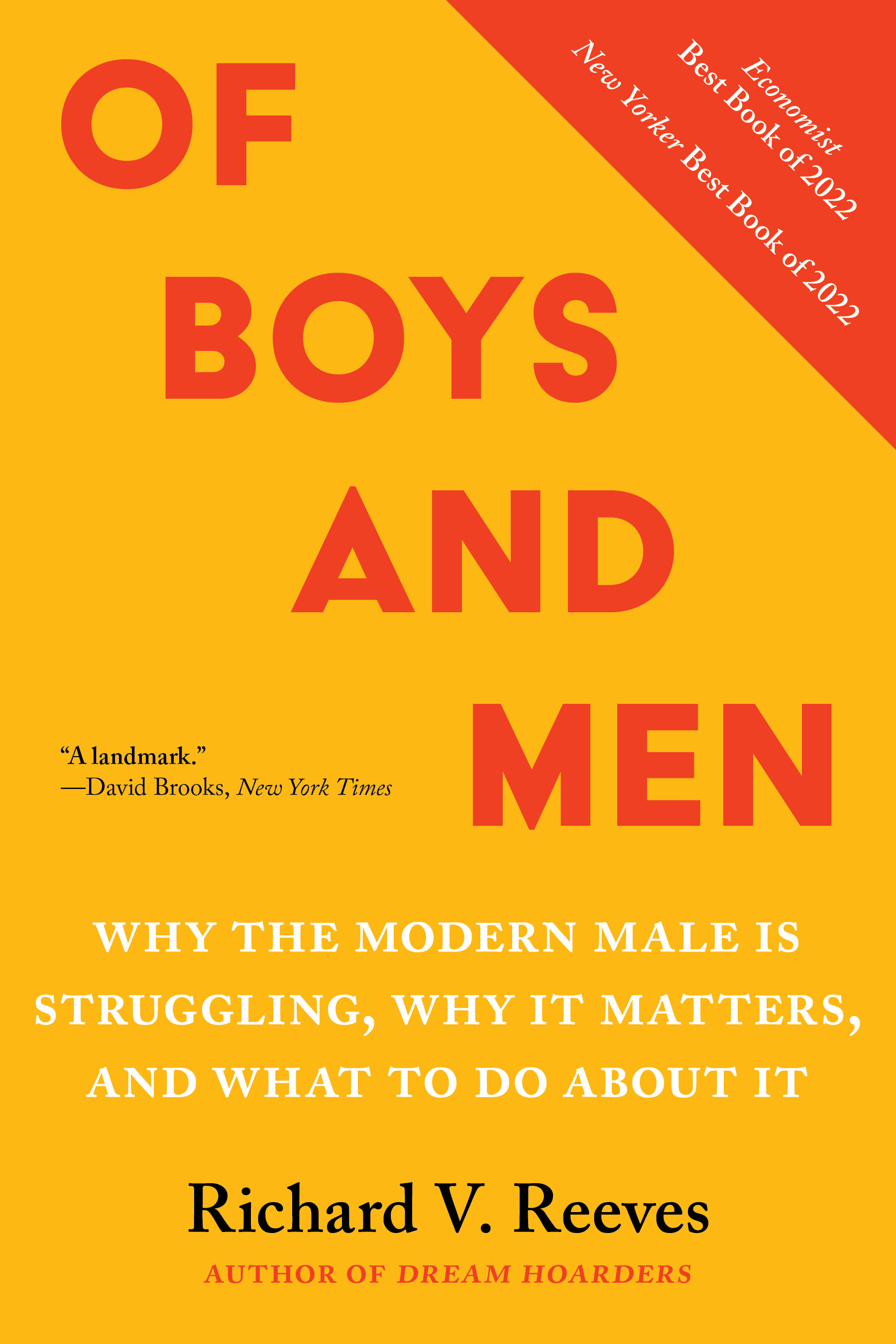
Of Boys and Men: Why the Modern Male Is Struggling, Why It Matters, and What to Do About It
Description:
Reeves assembled the data behind a story many institutions struggle to discuss clearly: boys and men are falling behind in school, college enrollment, and large parts of the labor market, with especially steep gaps for Black and working-class men. Rather than treating those outcomes as a character defect or as a threat to women’s progress, he examines their structural causes and proposes structural responses, including later school starts for boys, more male teachers, and stronger vocational pathways. The book’s argument pairs naturally with Benedict College’s example: when an institution redesigns support around the people it is losing, the numbers can move.
Author: Richard V. Reeves
Book Length: 264 pages (Brookings edition)
Release Date: May 21, 2024 (Brookings edition)
Ideal For:
Educators, parents of sons, policy readers, and anyone looking for the broader research context behind today’s Benedict College story.
Persistent gaps are rarely solved by demanding more motivation from the people experiencing them. Durable progress starts when institutions examine the structures producing the outcome and redesign those structures deliberately.
|
|
DAILY ACUMEN
Choice Architecture: Design Beats Discipline
Economists Richard Thaler and Cass Sunstein popularized a deceptively simple idea in their 2008 book Nudge: the way choices are arranged quietly determines what people choose. They called it choice architecture. Cafeterias that put fruit at eye level sell more fruit. Companies that make retirement savings the default get dramatically higher participation than those that ask employees to opt in. Nobody's willpower changed; the environment did.
The mental model worth keeping: when you see a repeated failure, in yourself or in an organization, ask whether the problem is motivation or design. Motivation-based fixes (try harder, care more, send another reminder email) are cheap to announce and expensive to sustain. Design-based fixes (change the default, move the friction, build the ritual into the calendar) cost effort once and pay out continuously.
Today's lead story is choice architecture at institutional scale. Benedict College did not lecture young Black men about valuing education; it redesigned the environment around them, mentorship in barbershops, recruitment through churches, a weekly ritual of dressing for the profession they want. If you keep failing at the same goal, stop auditing your character and start auditing your setup.
|
|
ENLIGHTENMENT
Free Game Picks
|
|
|
📣 Partner With Us: Get in front of an audience of over 1 million black professionals, business leaders, and policy influencers. Submit a partnership inquiry.
|
|
What'd you think of today's edition?
|
|
|
|

