
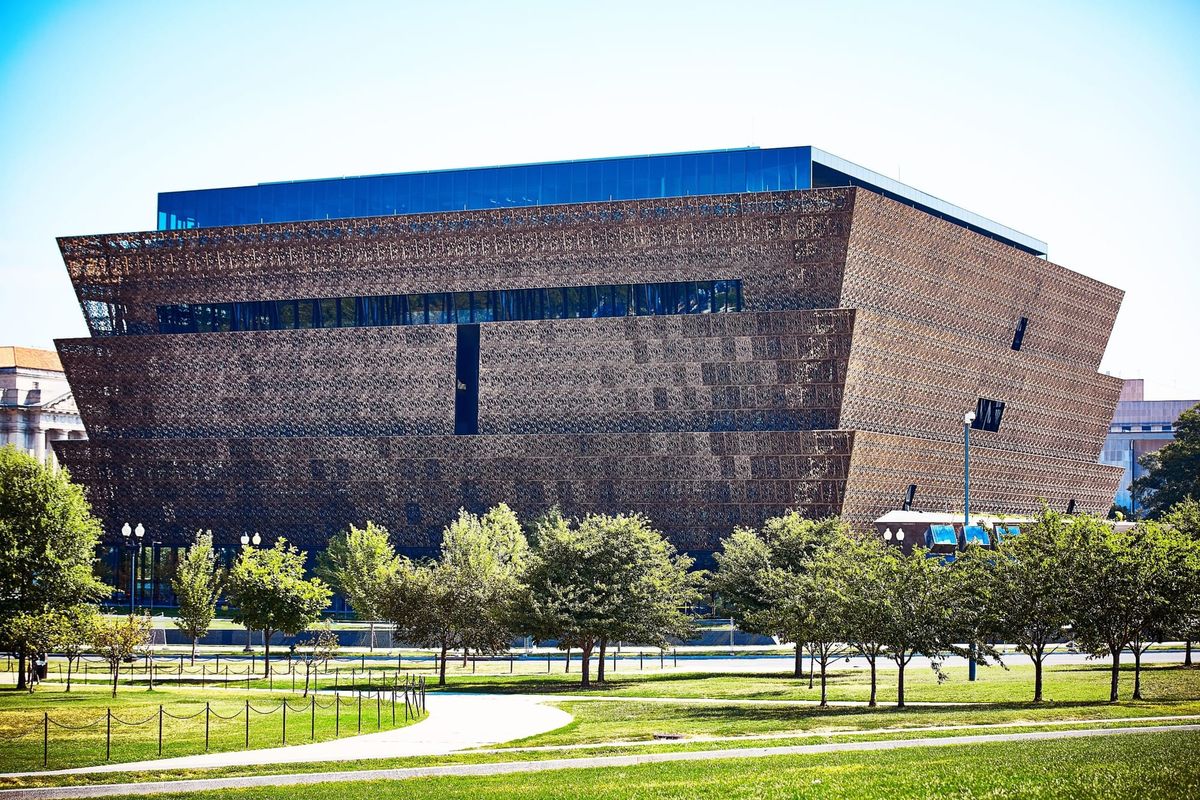
The National Museum of African American History and Culture turns ten this month, and it is celebrating the way you would expect an institution of its stature to celebrate. From September 24 through 27, the museum is hosting "The Reunion," a four-day festival under the theme "Welcome Home: Our Legacy Continues." There is a full day of activations on the anniversary itself, a conversation between founding director and current Smithsonian Secretary Lonnie G. Bunch III and journalist Laura Coates, a purple-themed fundraising gala at The Wharf hosted by Bill Bellamy with performances by Jermaine Dupri and DJ D-Nice, and a free community gathering to close it out. A 320-page catalog, "What a Dream Can Do," tells the origin stories behind artifacts like Harriet Tubman's hymnal and the Tuskegee Airmen training biplane.
The numbers behind the party justify the scale. Since opening on the National Mall in September 2016, the museum has welcomed nearly 14 million in-person visitors, educated more than 1.1 million students and teachers, and reached over 65 million digital visitors through its Searchable Museum platform. For an institution that took more than a century of advocacy to get built, and that Congress only authorized in 2003, the first decade is about as close to an unqualified success as a museum gets.
But the more revealing anniversary move is happening 600-odd miles south of the Mall. On September 19, five days before the museum blows out its candles, its exhibition "At the Vanguard: Making and Saving History at HBCUs" opens at the Clark Atlanta University Art Museum, the first stop on a national tour that runs through 2029.
Here is the detail that makes the tour worth paying attention to. The objects in the show were never the Smithsonian's. "At the Vanguard," which ran at NMAAHC from January 16 to July 19, is built entirely from the collections of five historically Black colleges and universities: Clark Atlanta, Florida A&M, Jackson State, Texas Southern, and Tuskegee. The more than 100 objects include first editions of Margaret Walker's novel "Jubilee" and her poetry collection "For My People," a notebook journal of Walker's from Jackson State, early scientific journals and pottery made by Tuskegee students, bricks those same students manufactured as tuition, one of the few known color films of George Washington Carver, a Frederick Flemister painting from Clark Atlanta's collection depicting mourners around a lynching victim, and photographs by Doris Derby, Chester Higgins, Earlie Hudnall Jr., and P.H. Polk documenting student activism and campus life.
In other words, the HBCUs were holding this history long before there was a Smithsonian museum to hold it. Nearly two-thirds of HBCUs operate museums, galleries, or archives, often filling preservation gaps that mainstream institutions ignored for generations. What NMAAHC did, through its HBCU History and Culture Access Consortium, a partnership launched in 2021 and backed in part by the National Endowment for the Humanities, was borrow that material, put it on the most prestigious stage in American museum culture, and then send it back out carrying a Smithsonian stamp. After Clark Atlanta (through December 13), the show moves to the University Museum at Texas Southern in January 2027, the Mississippi Department of Archives and History in Jackson that April, the Tuskegee University Legacy Museum in spring 2028, and FAMU in late 2028 into early 2029.
That is a notable reversal of the usual flow of cultural authority. Museums in Washington typically extract: artifacts come in from the provinces and stay. This exhibition runs the circuit in reverse. The national museum lends its validation, and the campuses keep the goods.
The timing gives the strategy extra weight. The museum's birthday lands in the middle of an open fight over how federal institutions tell American history. President Trump's March 2025 executive order, "Restoring Truth and Sanity to American History," accused the Smithsonian of promoting a "divisive, race-centered ideology," and that August the White House demanded exhibition materials from eight Smithsonian museums, directing them to replace what it called divisive language. In July, the White House Domestic Policy Council published a report accusing the Smithsonian of presenting "a radical view of American history," with the Smithsonian's 250th anniversary programming, the same "Our Shared Future: 250" umbrella under which NMAAHC is celebrating, squarely in its sights. The man who built NMAAHC, Lonnie Bunch, now runs the whole Smithsonian and is fielding the pressure personally.
No one at the museum has said the HBCU tour is a hedge against that pressure, and there is no evidence it was designed as one. The consortium predates the current fight by four years. But the structural effect is worth naming. An exhibition of Black history that lives on Black campuses, in Atlanta, Houston, Jackson, Tuskegee, and Tallahassee, is an exhibition whose future does not depend entirely on the politics of a single city. Whether or not that was the intention, it is the result: the story now has multiple homes, and most of them answer to communities rather than to the White House.
Ten years ago, the question was whether America would ever build a national museum of Black history. The answer turned out to be a building so successful it had to be experienced in timed passes. The question for the second decade is different: where does the authority to keep and tell that history actually reside? This anniversary suggests the museum's own answer. Partly on the Mall. And partly, as it always has been, on the campuses.
Free Game Takeaway
If you live near Atlanta, Houston, Jackson, Tuskegee, or Tallahassee, a Smithsonian-caliber exhibition is coming to your backyard between now and early 2029, much of it material these HBCUs rarely lend out. The specific dates worth putting on a calendar: Clark Atlanta University Art Museum through December 13, 2026; Texas Southern's University Museum January 9 to April 4, 2027; the Mississippi Department of Archives and History in Jackson April 24 to July 18, 2027; Tuskegee's Legacy Museum in spring 2028; and FAMU starting September 30, 2028. For educators, parents, and alumni, this is a low-cost, high-value field trip window, and HBCU museums on these campuses will likely see elevated attention and traffic worth supporting while the show is in town. If you cannot get to any stop, the museum's HBCU History and Culture Access Consortium digital archive already hosts more than 2,000 objects from these five collections online for free. Two larger signals to watch: first, whether the National Endowment for the Humanities funding that helped make this tour possible survives the current political fight over federal cultural spending, since that money is the plumbing behind exhibitions like this one. Second, watch how the White House review of the Smithsonian, now focused on anniversary-year programming, treats NMAAHC specifically. If pressure on the D.C. building intensifies, expect the museum to lean even harder into traveling shows and digital distribution, which would make local access to this history more important, not less.