
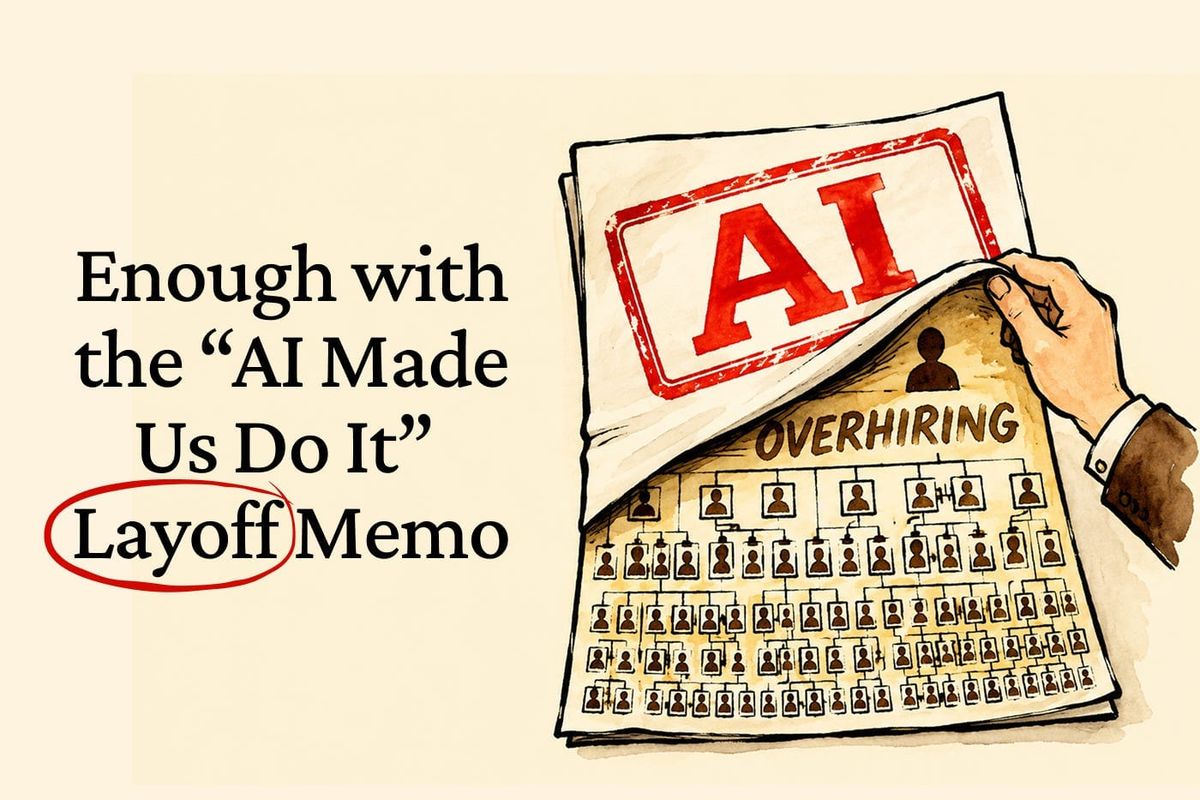
In February, Jack Dorsey told Block's shareholders that "intelligence tools have changed what it means to build and run a company," and cut roughly 4,000 people, close to 40% of the workforce. Block was not struggling. The same quarter, it reported gross profit growth of 24%. The stock surged on the news, by somewhere between 18% and 24% depending on which account you read.
That sequence, cut people, credit AI, watch the stock rise, has become the defining corporate ritual of 2026. Business Insider's running tracker counts more than 40 major companies announcing layoffs this year, including Pinterest, Coinbase, Meta, Snap, Cisco, Oracle, and Standard Chartered, with many explicitly naming AI as the reason. One tracker, Outsource Accelerator, puts AI-attributed U.S. layoffs at 205,000 through August. Challenger, Gray & Christmas, the outplacement firm whose numbers are the industry's benchmark, says AI has been the single most-cited reason for job cuts for five straight months, a first.
The details are striking. Cloudflare cut 20% of its staff, about 1,100 people, in the same quarter it posted record revenue of $639.8 million, up 34% year over year. CEO Matthew Prince wrote that most of those let go were "measurers," meaning middle management, finance, legal, and audit. Cisco cut nearly 4,000 jobs after beating profit expectations, with its CFO insisting the move was "really not a savings-driven restructure." Coinbase dropped 700 people, 14% of staff, as CEO Brian Armstrong described a future of "one person teams." Standard Chartered announced it will eliminate roughly 7,800 back-office roles by 2030, with CEO Bill Winters describing the plan as replacing "lower-value human capital" with investment capital. The bank had already hit its 2026 financial targets a full year early.
Notice the pattern. These are profitable companies. The workers leaving are not being rescued from failing businesses. They are being removed from healthy ones, and the market keeps applauding.
Which raises the question a growing list of insiders is asking out loud: how much of this is actually AI?
The skeptic bench is surprisingly deep. Sam Altman, whose company sells the technology in question, has acknowledged "some AI washing where people are blaming AI for layoffs that they would otherwise do." Nvidia's Jensen Huang called CEOs who blame AI for cuts "lazy." Marc Andreessen dismissed AI as "the silver bullet excuse" for unwinding pandemic-era overhiring. Oxford Economics concluded earlier this year that firms "don't appear to be replacing workers with AI on a significant scale." A Forrester survey found nearly six in ten hiring managers admit AI was cited as the reason for layoffs actually driven by budget cuts, revenue uncertainty, or the hangover from 2021 and 2022 hiring sprees. And a Gartner study of 350 firms, reported in May, found the companies making the deepest AI-cited cuts showed no improvement in financial returns.
Then there is Klarna, the cautionary tale. The fintech announced its AI assistant was doing the work of 700 customer service agents, cut deep, then quietly reversed course and started rehiring, with its CEO conceding the company "went too far" on cost-cutting at the expense of quality.
Even Challenger's own data carries a tell. In January, companies attributed 7% of announced cuts to AI. By May, that figure was nearly 40%, rising every single month in between. Either AI capability quintupled in five months, or the explanation got more fashionable. The evidence points toward fashion. Layoffs announced with an AI rationale tend to be rewarded by investors, which gives every CEO watching Block's stock pop a reason to reach for the same script. Just 21 announcements of 1,000 or more cuts account for 103,000 of the year's AI-attributed layoffs. This is a big-company behavior, and big companies are exquisitely sensitive to what makes a stock move.
Here is the twist that complicates the cynicism, though: the displacement underneath the excuse is real.
Government payroll data shows the information and financial activities sectors, where AI adoption is fastest, shedding an average of 28,000 jobs a month in 2026, even as the broader labor market added more than 113,000 a month through May. Overall layoffs are actually down 40% from the first half of last year, and July's total was the lowest monthly figure in two years. Andy Challenger himself puts it plainly: AI is shifting the labor market, not dismantling it. IBM says it has replaced roughly 200 HR roles with AI agents, even while tripling entry-level hiring in AI and hybrid cloud. The World Economic Forum found 41% of companies worldwide expect to shrink their workforces within five years because of AI.
So the honest read of 2026 looks like this. The economy is still adding jobs. But the composition of the job ladder is changing underneath workers, and it is changing at the bottom rungs first. The roles being automated, consolidated, or excused away are customer service, clerical work, claims processing, data entry, junior corporate positions. Entry-level. Back office. The cubicle jobs.
The Wall Street Journal documented what that means on the ground in Phoenix, the country's call-center capital, a city that built a genuine middle class on back-office work and is now watching AI pile onto decades of offshoring losses. Those cubicle jobs were never glamorous, but they were a ladder: steady wages, benefits, a path from a high school diploma or a no-name degree into the middle class. That ladder is being sawn at the bottom.
And AI is not even working alone. New research from the Federal Reserve Bank of New York found that unemployment among young college graduates hit 5.6% in March, up from 3.6% in 2019, and estimates that remote work explains roughly 64% of the increase. Employers, it turns out, are reluctant to hire fresh graduates onto distributed teams because training them from afar is hard. Over the same period, unemployment for experienced graduates actually fell. The door is narrowing precisely where people enter, from two directions at once.
This is where the racial math comes in, and it deserves more attention than it gets. Research from the Joint Center for Political and Economic Studies has long shown that Black workers are heavily concentrated in the occupations most exposed to automation: cashiers, secretaries and administrative assistants, office clerks, receptionists, customer service. About 24% of Black workers sit in just 20 high-automation-risk occupations. Customer service roles in particular have been one of the more accessible corporate entry points for workers without elite credentials, which means a disproportionate share of the people standing on those vanishing bottom rungs are Black. When a bank CEO talks about replacing "lower-value human capital," it is worth being precise about whose capital he is talking about.
What happens next? Watch the Klarna pattern. If the AI claims outrun the actual capability, expect a wave of quiet rehiring over the next year or two, announced with far less fanfare than the cuts. Watch Pinterest, which told the SEC its restructuring will be complete by the end of this quarter. And watch whether any of the companies that blamed AI start reporting the productivity gains to match. So far, per Gartner, the deepest cutters have not.
The CEO who says AI took your job may be telling the truth. He may also be telling Wall Street a story it pays to hear. In 2026, those two things are nearly impossible to tell apart from the inside of a termination letter, and that ambiguity is entirely the point.
Free Game Takeaway
Treat every 'AI-driven restructuring' announcement, at your own employer especially, as a claim to be audited rather than a fact. Ask what the company actually deployed, which tasks it demonstrably performs, and whether the plan comes with retraining or just severance. A company offering real transition support believes its AI story; one offering only exit paperwork may be using AI as cover for cost-cutting, and Klarna has already shown those companies sometimes come back begging for the same skills they cut. Practically: if your role is repetitive, rule-based, and remote-friendly (support tickets, data entry, claims, scheduling), that is the highest-risk zone right now, so start building the skills that sit next to the automation, like managing AI tools, handling the exceptions the software fumbles, and doing the client-facing judgment work that got Klarna's customers angry. If you are early in your career, the New York Fed's findings carry a blunt lesson: the junior roles most likely to still exist are the ones with in-person training attached, so weigh mentorship and proximity more heavily than remote flexibility when choosing a first job. And if you watch these companies as an investor, the signal worth tracking is whether AI-cited cuts eventually show up as margin expansion; a Gartner study reported this year found the deepest AI-cited cutters have seen no improvement in financial returns, which suggests the market may be rewarding a narrative that the income statements have not yet earned.